Ruth Bader Ginsburg Faced Closed Doors in Law. Allies Helped Her Open Them.
Shut out of many legal jobs, Ruth Bader Ginsburg found allies, wrote a key Supreme Court brief with a colleague and built a wider fight for equal rights.

The lesson
Closed doors are easier to open when other people push with you.
- Let the people who believe in you speak up for you.
- Build your work around the real problems people bring to you.
- Give credit to the people who did the work before you.
The challenge
Ruth Bader Ginsburg wanted to be a lawyer. She studied at Harvard Law School. When her husband, Martin, took a job in New York, she moved to Columbia Law School. She graduated tied for first in her class.
That was an excellent record. But in her time, a great record was not enough for a woman in law.
The problem
Decades later, Ginsburg described the doors that closed on her. She recalled that Justice Felix Frankfurter would not hire a woman as his clerk. A clerk is a lawyer who helps a judge. She said Judge Learned Hand also explained why he would not hire her.
She remembered law-firm job sheets marked "men only." She named three things that counted against her: being Jewish, being a woman and being a mother.
She later said she worked one summer at a law firm, but it did not offer her a permanent job. She linked that to the firm offering a job to Pauli Murray.
So even a top student had trouble finding work.
What they did
Ginsburg did not open the first door alone. A Columbia professor, Gerald Gunther, spoke up for her.
Gunther later described what happened in a 1993 letter supporting her nomination. He said Judge Edmund Palmieri hesitated to hire a woman clerk. Gunther urged him to think again. Palmieri hired Ginsburg, and she clerked for him from 1959 to 1961.
Next, Ginsburg taught law at Rutgers from 1963 to 1972. The barriers did not vanish. She later recalled being paid less than male colleagues because her husband had a good job.
Her focus grew step by step. She did legal research in Sweden that compared laws across countries. People with sex discrimination complaints also brought them to her through the New Jersey branch of the ACLU. These real cases pulled her toward women's rights.
Then came a big case, Reed v. Reed. An Idaho law said that when courts chose someone to handle a dead person's property, men must be preferred over women. Sally Reed challenged that law.
Ginsburg and Mel Wulf, the ACLU's legal director, wrote the brief together. A brief is the written argument sent to the court. Sally Reed's own lawyer from Boise, Allen R. Derr, argued the case in person.
Ginsburg also added two earlier women's-rights lawyers to the brief: Pauli Murray and Dorothy Kenyon. A law review tribute says they had not formally worked on the case. She included them to honor the work they had done before her.
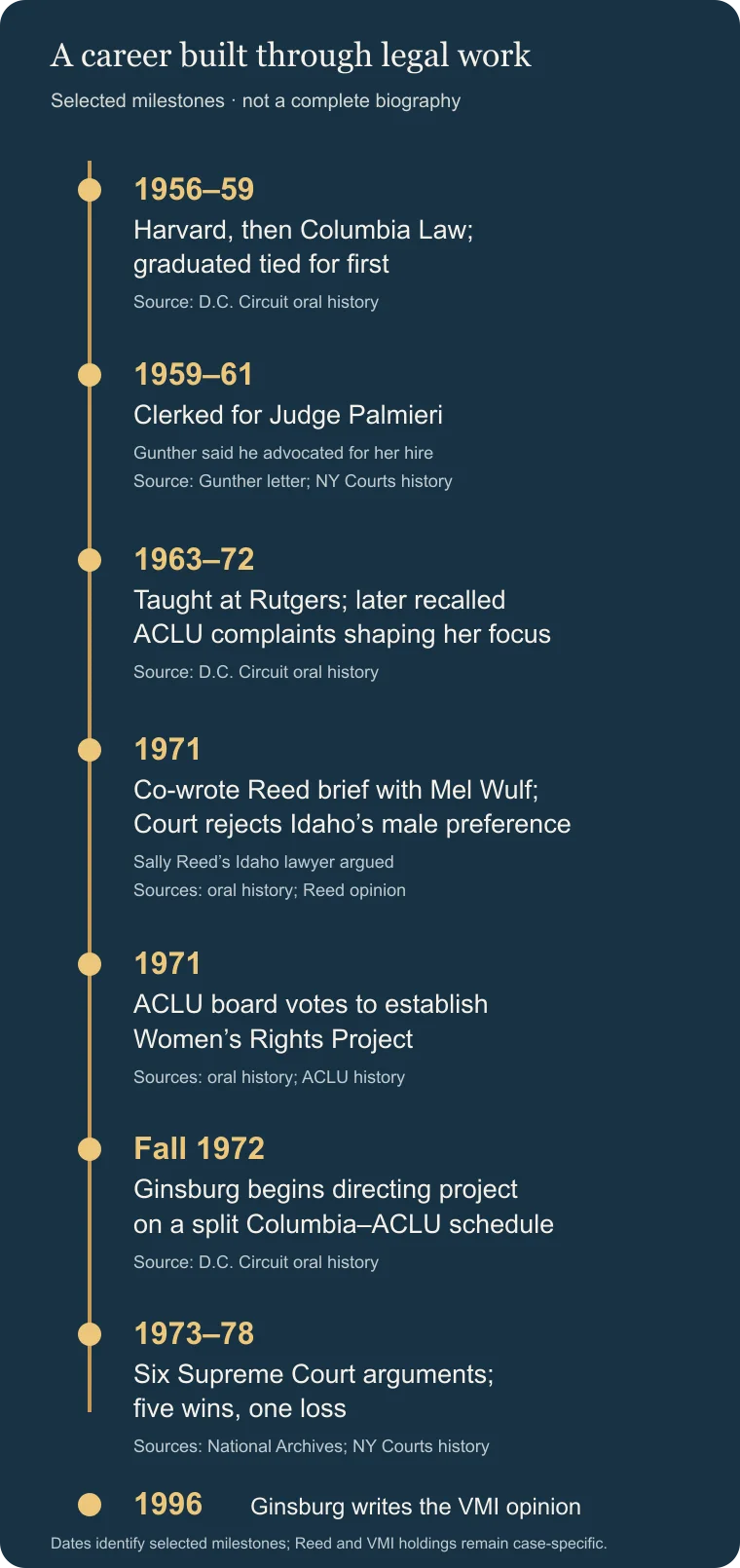
Key steps in Ginsburg's path. The ACLU voted to start its project in 1971; she began leading it in fall 1972.
What happened next
The Supreme Court ruled for Sally Reed. All the justices agreed that Idaho's rule favoring men broke the promise of equal protection under the law.
The win was important, but it was one step. A stronger legal test for laws that treat men and women differently came later. The ACLU points to a 1976 case, Craig v. Boren, as the one that set that test.
After Reed, the ACLU board voted at the end of 1971 to start a Women's Rights Project. Ginsburg recalled that the board asked her to lead it. In fall 1972, she began splitting her time between Columbia and the ACLU.
From 1973 to 1978, she argued six cases before the Supreme Court and won five. She lost one, Kahn v. Shevin. She later said she thought that case came too soon. The work moved forward case by case, with wins and losses.
In 1996, Justice Ginsburg wrote the Supreme Court's main opinion in United States v. Virginia. The Court held that the Virginia Military Institute could not shut out all women. It also said the state's separate program for women did not fix the problem.
This story inspires because so many people moved it forward. A professor spoke up. A judge changed his mind. Clients brought real problems. Lawyers wrote and argued together, and earlier women got the credit they had earned.
Each ruling had limits, and hard work could not promise any single job or win. But together, these steps opened doors that had been shut.
Try this today
- Think of someone who could speak up for you. Send them a short note about one goal you are working toward.
- Write down one problem a friend, customer or neighbor has told you about. Note one small way your skills could help.
- Thank someone whose earlier work made your path easier. Name exactly what they did.
Who has opened a door for you, and whose door could you help open?
Sources for this story: S01, S02, S03, S04, S05, S07, S08, S09, S10, S11, S12, S13, S14. Full list below.
Join the conversation
Vote in the community poll and see the latest results from Armored Kitten on Telegram.