Sara Blakely's Calls Went Nowhere. So She Drove to the Mills in Person.
When hosiery makers did not respond to her calls, Sara Blakely kept her day job, changed her approach, and found a mill owner willing to help build her first footless hosiery.

The lesson
When one route keeps saying no, keep the goal and try a different way to reach the right person.
- Write down exactly what your first try solved and what it did not.
- Change the method when it stops working, and keep the goal.
- Let other people in: makers, family and customers can all help.
The challenge
Sara Blakely sold fax machines door to door. She has said she did this for seven years. She had no background in business or fashion, she had never taken a business class, and she had saved $5,000.
She has also described a family habit. At dinner, her father asked her and her brother what they had failed at. She said this helped her see failure as something to learn from.
In 1998, Blakely was getting ready for a party. She wanted the smooth look of control-top hosiery under light-coloured trousers. But she did not want the hosiery feet to show in her open-toed shoes. So she cut the feet off a pair.
The look worked, but the cut fabric rolled up her legs. Now she had a clear question: how could she make a garment like this stay in place?
The problem
Blakely needed someone to make the product. She searched for hosiery mills and began calling them.
For months, she says, nothing useful came back. Calls ended quickly or never reached the person who could decide. She had an idea, but no way to get it made.
Protecting the idea was hard too. Blakely says patent lawyers quoted her between $3,000 and $5,000. That was close to all the money she had saved.
What they did
Blakely did not quit her job, and she kept selling fax machines while she worked on the idea.
When the phone calls failed, she changed her approach. She took a week off and drove through North Carolina to visit hosiery mills in person. She recalls being asked who she was with and who was paying for this. Her answer was that she was on her own. The trip did not bring a yes right away.
She also learned what she could on her own. She bought a book about patents and trademarks and began writing her patent application herself. Later, a patent lawyer helped her finish it. Her mother, an artist, drew a sketch for the prototype.
About two weeks after Blakely got home to Atlanta, a mill owner called. He agreed to help make a prototype, a first test version of the product. Blakely remembers that his daughters helped change his mind. In one interview she said he had two daughters; in another, three.
The prototype still took work. Blakely says she worked on it at night and on weekends for about a year.
She also checked whether people wanted it. A sales associate at Neiman Marcus told her that customers had already been making their own homemade versions. Later, Blakely showed the product to a buyer, and it was placed in seven stores.
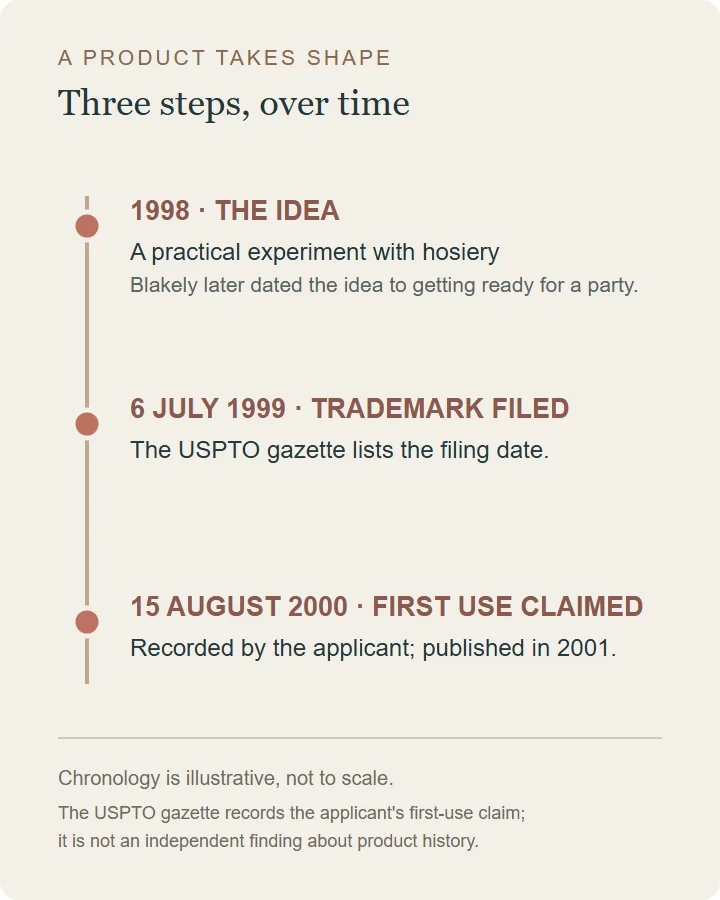
Three dates in the story: the idea in 1998, the trademark filing in 1999, and a "first use" date in 2000. That last date was supplied by the applicant, not checked by the government office.
What happened next
Public records show the idea becoming a named product. The SPANX trademark was filed on July 6, 1999, and the record lists August 15, 2000, as its date of first use. That record was published on June 26, 2001.
Blakely's story inspires because she kept changing her approach. Phone calls failed, so she drove to the mills. Lawyers would have cost nearly all her savings, so she started learning. And she let others help: a mill owner, his daughters, her mother, a sales associate and a store buyer.
The work was hers. But the chance to make the product depended on other people saying yes.
One honest note: Blakely had a job, some savings and time she could take off, which many people do not have. One success cannot show that pushing on will bring the same result for everyone.
Try this today
- Write down one idea you are working on. List what your first try solved and what it did not.
- Name one person who can judge the part you cannot do yet. Ask them one specific question this week.
- If one approach keeps failing, write two other ways to reach the right person. Pick one to try.
What is one "no" in your life that might mean "try another way"?
Sources for this story: S01, S02, S03, S04, S05, S06. Full list below.
Join the conversation
Vote in the community poll and see the latest results from Armored Kitten on Telegram.