SpaceX's First Three Rockets Failed. Its People Kept Working Toward the Fourth.
After three Falcon 1 rockets failed, Gwynne Shotwell and the SpaceX team kept explaining, planning and pitching, and the fourth flight reached orbit in 2008.

The lesson
Before you decide what a failure says about you, find out what it says about the attempt.
- Look for the specific cause of a setback, so you know what to change.
- Keep doing the next useful task, even before you know how things will end.
- Welcome practical help from colleagues, customers and partners.
The challenge
SpaceX was a young rocket company. It wanted to put a small rocket, the Falcon 1, into orbit, the path a spacecraft takes around Earth.
Gwynne Shotwell joined SpaceX in 2002 as vice president of business development. Her job was to build relationships with customers and grow the company's launch business. Elon Musk was its founder.
In a 2012 interview, Musk talked about the company's long odds. He said, "every now and again, the little scrappy company wins." But in the early years, winning was far from certain.
The problem
SpaceX's first three Falcon 1 flights all failed to reach orbit. News reports in August 2008 described the third failure.

A real excerpt from NASA's 2008 record. Its September 28 entry reports the Falcon 1 flight that finally reached orbit.
Each failure meant a lost flight. It also left customers needing answers.
A NASA technical report later explained what went wrong on the third flight. The rocket had a new engine, the Merlin 1C. After the engine shut down, leftover fuel gave it a small, brief push. Then the rocket's two parts, or stages, separated.
Because of that extra push, the first stage caught up with the second stage and hit it. That damaged the second stage's engine. The gap between engine shutdown and separation was 1.5 seconds. That was too short for the new engine.
The report also said the engine's tests at sea level had hidden this effect.
So the failure had a clear physical cause, not a vague one. It was something specific that could be studied.
What they did
Shotwell had two jobs at once. She went to Scotland to explain the failed launch to customers. At the same time, SpaceX was preparing a proposal for NASA, to carry supplies to the space station.
Years later, in a Stanford interview, she described one night in Glasgow. Her husband was asleep. She sat in the bathroom with the shower running and talked by phone with colleagues in the United States. Together, they updated the prices in the NASA proposal.
SpaceX did not stand alone. In 2006, NASA had signed a $278 million agreement with SpaceX, through a programme called Commercial Orbital Transportation Services. It came with goals and milestones. This support was in place before Falcon 1 ever reached orbit.
The team now faced a fourth launch. Shotwell later said Musk saw it as their last chance. She thought they might manage a fifth. They never had to find out who was right.
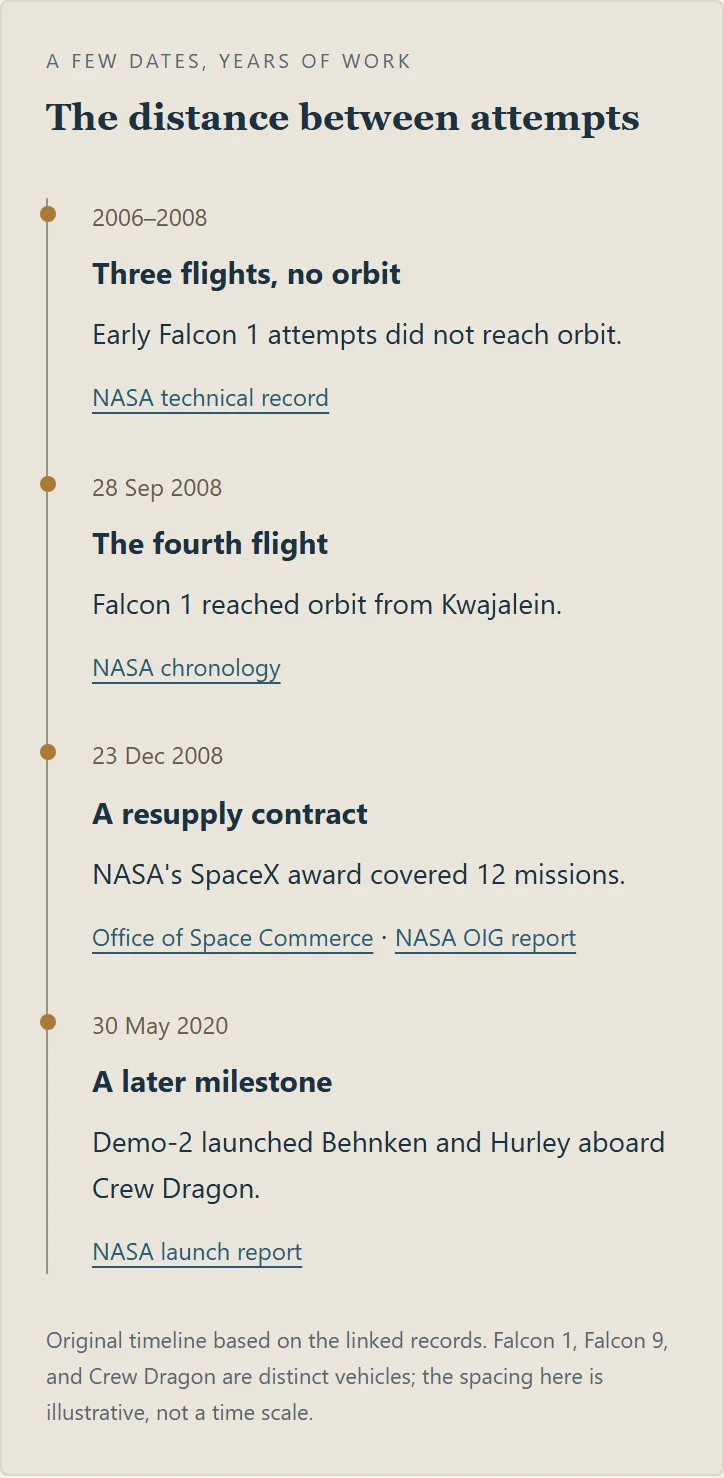
Key steps from the early Falcon 1 failures to the 2020 crew flight. The spacing is not to scale, and the 2020 flight used a different rocket.
What happened next
On September 28, 2008, the fourth Falcon 1 reached orbit. It launched from Omelek Island in Kwajalein Atoll.
Later that year, on December 23, NASA awarded supply contracts for the space station. One went to SpaceX and one to Orbital Sciences. SpaceX's contract covered 12 missions and was worth about $1.6 billion. It was payment for future work, not a prize for one good launch.
Years of work followed. On May 30, 2020, a SpaceX Falcon 9 rocket launched a Crew Dragon spacecraft. On board were NASA astronauts Robert Behnken and Douglas Hurley. NASA called it a full test of the system for carrying crews.
This story inspires because people kept doing useful work while the outcome was still unknown. Shotwell explained a failure and priced a proposal in the same trip. And a partner, NASA, had backed the work before the first success.
One honest note: this is the story of a company that made it. Many people keep trying, learn and accept help, and still do not reach their goal. Their effort matters too.
Try this today
- Think of one thing that went wrong this week. Write what you tried, what happened, and one specific cause you can check.
- Choose one small change you can test. Set a reminder to try it within the next few days.
- Ask one person who knows the subject to look at your plan for 10 minutes.
What did your last attempt teach you about the attempt itself, not about you?
Sources for this story: S01, S02, S03, S04, S05, S06, S08, S09, S10, S11. Full list below.