Mary Seacole Was Turned Away. She Built Her Own Way to the Crimea.
When official wartime routes stayed closed, Mary Seacole used her skills, a business partner and her own money to reach the Crimea, and she paid a real price for it.

The lesson
When officials say no, you can still find your own way to use your skills.
- Use what you already know: your experience, your skills and the people who trust you.
- Find partners and get the permission you need, so a new plan can really work.
- Count the cost before you start, because a brave plan can still carry real risk.
The challenge
Mary Seacole had experience in caring for sick people. She also had experience in running a business. During the Crimean War, she wanted to use those skills to help.
We know her story mainly from her own book. In 1857, she published Wonderful Adventures of Mrs. Seacole in Many Lands. In it, she looked back on the war years.
She warned her readers about one thing. She said she kept no diary, so her memory of the order of events might not be exact. That is worth keeping in mind as we follow her story.
The problem
In London, Seacole tried to join the official plans for wartime nursing. She says she asked more than one person and more than one office for a place.
She says she was turned away.
She wrote that she wondered if her colour counted against her. That was her own feeling about what happened. Her book does not show the reason behind each decision.
A popular version of this story says Florence Nightingale personally rejected her. The sources used here do not show that.
What is clear is that the official routes did not open for her. She had to decide whether to keep waiting or to find another way.
What they did
Seacole chose another way. She later wrote that she decided to go to the Crimea on her own responsibility. She would pay for it herself and set up a business there.
She did not do it alone.
First, she used what she already knew. Her past work in care and business helped her plan what goods might be needed.
Second, she asked for advice. She wrote that a medical friend helped her decide how to spend her small amount of money on medicines.
Third, she found a business partner. His name was Thomas Day.
Fourth, the business needed permission from the army. A historian, Mike Hinton, later studied a letter from Day to Major General Richard Airey. In it, Day asked for permission to open a business near the British camp. Hinton reports that the army approved it, with conditions.
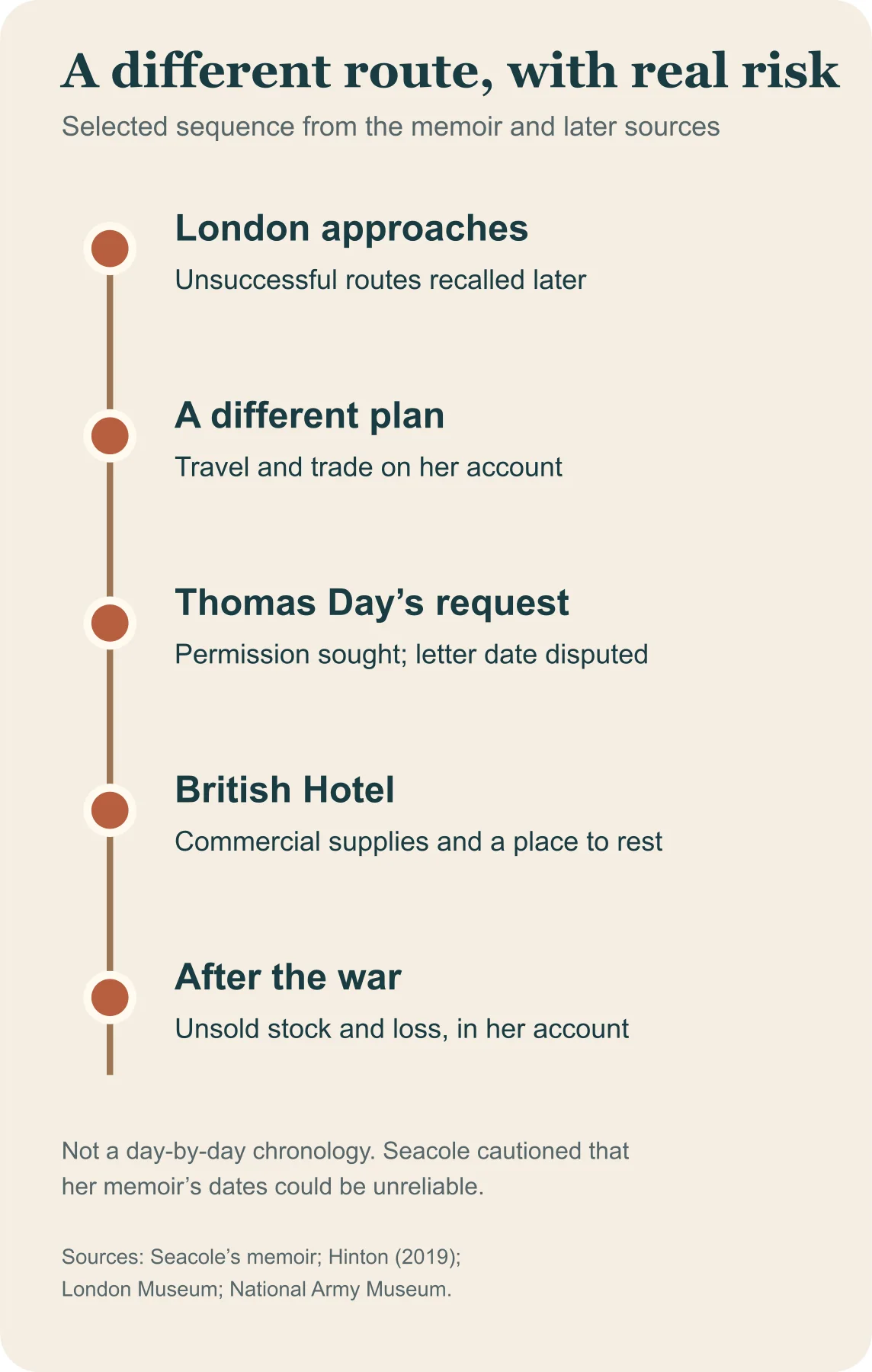
Selected steps in Seacole's plan, not a day-by-day record. Seacole said her own order of events might be wrong, and the date of Day's letter is not certain.
The business became known as the British Hotel. Despite its name, the sources describe it as a store or canteen. People could buy supplies there and find a place to rest. The sources do not show that it was a hospital, an inn with beds for the night, or a formal nursing service.
That still mattered. In hard conditions near the front, a place for supplies and a short rest was useful to people.
So her plan was her own, but it rested on many others. It needed her skills, a partner, a friend's advice and army approval.
What happened next
The ending was not a neat reward.
When the war ended, Seacole wrote, she was left with stock she could not sell or bring home. She said she returned financially ruined. A London Museum overview also describes her money troubles after the war.
Her plan had given her a real way to serve when the official routes were closed. It also put her own money at risk, and she lost it.
That is why her story is honest and still inspiring. She did not keep waiting for an official route to open. She looked at what she could actually do, found partners, and acted. But trying harder did not protect her from loss.
Her story invites good questions for anyone facing a closed door. Is there another way to help? What skills can I bring? Who could share the work? What permission do I need? And who pays if the plan fails?
Try this today
- Think of one door that has stayed shut for you. Write down two other ways you could still use your skills toward the same goal.
- Name one person who could advise or partner with you. Send them a short message this week.
- Before you start a new plan, spend 10 minutes listing what it might cost you if it fails.
What could you build yourself, with the right partners, if the usual route stays closed?
Sources for this story: S01, S02, S03, S04, S05. Full list below.
Join the conversation
Vote in the community poll and see the latest results from Armored Kitten on Telegram.