The Scholarship Opened a Door. It Did Not Remove the Wall.
A Baroda scholarship took Ambedkar to Columbia and required him to return to state service. In his later account, caste soon shut the door on lodging.

B. R. Ambedkar’s education, a Baroda lodging crisis, and the people and institutions around his work
On the eleventh day, the shelter was gone. In his 1936 essay Waiting for a Visa, B. R. Ambedkar recalled that after returning to Baroda to serve the state that had financed his education, he was ordered to leave the Parsi inn where he had found a room. His account makes clear that the crisis was not simply about finding a room: it was the caste boundary he says followed him into the lodging search. The essay is retrospective and warns that its dates are confused. Ambedkar’s essay describes the eleven-day stay and date uncertainty. [C01]
This is more than a tale of talent rewarded. A scholarship, teachers, classmates, friends, and public institutions helped Ambedkar study and work. Yet sponsorship and achievement did not make caste exclusion disappear. Support widened choices while the structure that constrained them remained. Columbia history records both scholarship and later barriers. [C02]
A scholarship built around a return
The Baroda State scholarship sent Ambedkar to Columbia University in 1913. The university’s historical timeline says the award was for three years and records his study across economics, history, sociology, philosophy, and other fields. It also names professors he studied under, including economist Edwin Seligman and philosopher John Dewey. The timeline draws on a mix of archival materials and later biographies, so its claims should be read with those layers in view. Columbia’s Ambedkar timeline identifies the scholarship and the academic community around him. [C03]
There is a small but telling detail in Ambedkar’s own account: the education came with an obligation. In Waiting for a Visa, he says the state had educated him and that he was therefore bound to serve it. Columbia’s timeline likewise describes his return to Baroda service as a condition of the scholarship. The state’s support was not an abstract vote of confidence; it was a funded route tied to public service. Ambedkar essay and Columbia timeline record the obligation. [C04]
A reproduced Baroda State expenditure account lists costs associated with Ambedkar’s education, including clothing, travel, books, and fees. It is not the original ledger and cannot tell us everything about the scholarship’s administration. Still, it shows study as a material investment, not a degree willed into existence by one student alone. The account appears in *Dr. Babasaheb Ambedkar: Writings and Speeches*, vol. 17. [C05]
At Columbia, support also came through relationships. The university timeline identifies Naval Bhathena as Ambedkar’s roommate and lifelong friend, and quotes a 1930 alumni account in which Ambedkar praised classmates and professors as among his best friends. Dewey, Seligman, James Shotwell, and James Harvey Robinson appear in that recollection. These details come through Columbia’s historical presentation and cited materials; they do not mean mentors alone explain his work. Learning is social: a student’s effort unfolds in rooms, seminars, and relationships made possible by others. Columbia timeline points to the cited alumni account and archive. [C06]
Returning to a city that would not house him
Ambedkar’s account of Baroda is striking because it is so specific about ordinary needs. He needed a place to sleep while working for the state. In the essay, he says he found temporary lodging at a Parsi inn under an assumed identity, then sought a state bungalow through official channels. On the eleventh day, he recalled, a group of Parsi men confronted him and ordered him to leave before evening. The essay describes this as an experience shaped by caste discrimination; it should be read as Ambedkar’s recollection, not as a transcript independently corroborated line by line. His essay is the source for this account. [C07]
He also recounts turning to acquaintances. One friend, he wrote, sympathized but warned that the household servants would leave if Ambedkar stayed. Another had to consult his wife. The episode does not fit a clean “one person believed, so everything changed” pattern. People could care about him and still be constrained by household norms and the caste system. Ambedkar wrote that he eventually left Baroda after eleven days. He also said he had declined other opportunities because he wanted first to serve the Maharaja who had financed his education. That choice and its cost are part of his retrospective explanation; the essay itself gives no reason to turn it into a universal formula for what a person should do. Ambedkar essay records his account of the friends and departure. [C08]
The chronology is not settled. Ambedkar’s essay flags its own dates as confused; Columbia’s timeline places his return in 1917. This article leaves the precise year secondary to what both records support: he returned under a service obligation and encountered caste-based barriers. Ambedkar essay and Columbia timeline show the discrepancy. [C09]
Support could help—and still not end exclusion
The same Columbia timeline says Parsi friends helped Ambedkar with tutoring and accountancy work, while his accounting practice failed when clients learned his caste. It credits Lord Sydenham’s recommendation with helping him obtain a college teaching position, where some colleagues reportedly objected to sharing a water jug. The timeline relies on later biographies, not a contemporaneous personnel file. Columbia timeline supplies this later chronology. [C10]
Together, these episodes resist an easy arc from rejection to triumph. Friends could help; a recommendation could open employment. Yet caste could undermine a professional practice and follow him into a new post. Support mattered, but could not itself remove the system that limited what it could secure. People need relationships and institutions that create room to act, while the conditions around them still demand change. Ambedkar essay and Columbia timeline provide the episodes behind this reading. [C11]
From scholarship recipient to committee chair
Decades later, Ambedkar served in a very different public role. The published transcript of the Constituent Assembly’s proceedings for August 29, 1947 records a seven-member committee to scrutinize a draft Constitution and suggest amendments. It names Ambedkar among the members. A revised motion clarified that the committee would review a draft prepared by the Constitutional Adviser, giving effect to decisions already made in the Assembly, and submit the committee’s revised text back to the Assembly for consideration. The Assembly debate transcript records both the membership and the committee’s remit. [C12]
Ambedkar later became the committee’s chair. In his closing address to the Assembly on November 25, 1949, he recalled that the committee had elected him and then distributed credit: to Constitutional Adviser B. N. Rau, fellow committee members, Chief Draftsman S. N. Mukherjee and his staff, and the Congress Party for the order and discipline it brought to Assembly proceedings. His own account is unusually clear about the work being shared. The Assembly record describes a committee and a legislature that continued to consider and decide the text; it does not support calling Ambedkar the Constitution’s sole author. The November 25 debate transcript records his acknowledgment of that shared work, while the August 29 record sets out the committee’s remit. [C13]
His story began with an institution paying for education and asking for service in return. It moved through classrooms, friendships, a lodging crisis, and work tested by caste. Later, he chaired a collective task while the Assembly retained authority to consider the result. None of these milestones cancels the others.
For a reader facing a blocked path, the takeaway is not “believe and the wall will fall.” Separate personal effort from what depends on others and on the surrounding system. Ask for practical help; recognize the people who provide it; and do not mistake a few supporters for the removal of a structural barrier. Perseverance can matter without guaranteeing an outcome, and achievement can be substantial without being solitary. The memoir and November Assembly address ground this reflection. [C14]
Generated symbolic editorial illustration. It does not depict Ambedkar, a documented room, or a specific historical event.
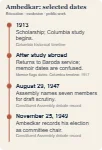
Selected chronology based on Columbia University’s historical timeline, Ambedkar’s retrospective essay, and the Constituent Assembly debate record. It does not resolve the conflicting date sequence in the memoir.
Sources and limits
Ambedkar’s 1936 essay is the central Baroda source; written roughly eighteen years later, it flags its dates as confused. Columbia’s historical timeline draws on archival records and later biographies and supports the education, friendship, tutoring, employment, and 1917 references. The Baroda expenditure account is a published reproduction, not an original ledger examined here. The Constitution section uses Assembly debate records for the committee’s membership, remit, chairmanship, and shared work. Ambedkar is not presented as sole author, and persistence is not treated as a guarantee.