Zaha Hadid's Winning Design Was Never Built. A Fire Station Became Her First Building.
After her prize-winning Peak design stayed on paper, Zaha Hadid kept working, and a company's need for a fire station gave her team a first completed building.
The lesson
Keep your work alive on paper, because a real chance can come from an unexpected need.
- Keep working on your ideas, even when they are not built yet.
- Welcome a practical project. A small real job can be a big first step.
- Build with a team, and share the credit.
The challenge
Zaha Hadid was an architect. She designed buildings and taught, and she ran her own office.
In 1983, she won a design competition for the Peak, a leisure project planned for Hong Kong. It was a big public win. People in her field noticed her work.
But a design is not a building. To build, an architect needs a client who will pay for it and see it through.
The problem
The Peak was never built. It stayed on paper.
The reasons are not fully clear. Later profiles say the developer went bankrupt. But in a 1996 interview, Hadid said she did not know what went wrong. She linked the timing to the change in Hong Kong's political future.
After that, completed buildings were rare for her. There was a long gap between her graduation and her later building jobs.
Hadid later spoke about barriers she felt in British private building work. In a 2008 interview, she talked about a male "brotherhood". But she also said she could not say for sure whether being a woman or being foreign explained her own experience.
So she had a major win, a working office and many designs. What she did not yet have was a finished building.
What they did
Hadid did not stop working. She kept teaching and running her practice. Her office kept developing new designs, and her work appeared in exhibitions. She worked with collaborators along the way.
Then a chance came from a company called Vitra. Its campus had a practical problem. In 1981, a major fire had struck the campus. The company rebuilt and decided it needed its own fire brigade. A fire brigade needs a fire station.
Rolf Fehlbaum, Vitra's longtime leader, later described what happened next. Vitra had been thinking about working with Hadid on furniture. Her projects, he said, existed as drawings. When the company needed a fire station, he was drawn to the strong sense of movement he saw in her work.
Fehlbaum said the link came about through a chain of contacts and coincidences. In his telling, it was a client with a real need, choosing a designer whose work drew him in.
Hadid did not build it alone. The Zaha Hadid Foundation credits the design to Hadid and Patrik Schumacher. Schumacher was the project architect, the person who guides a design into a real building. A wider design team also worked on it.
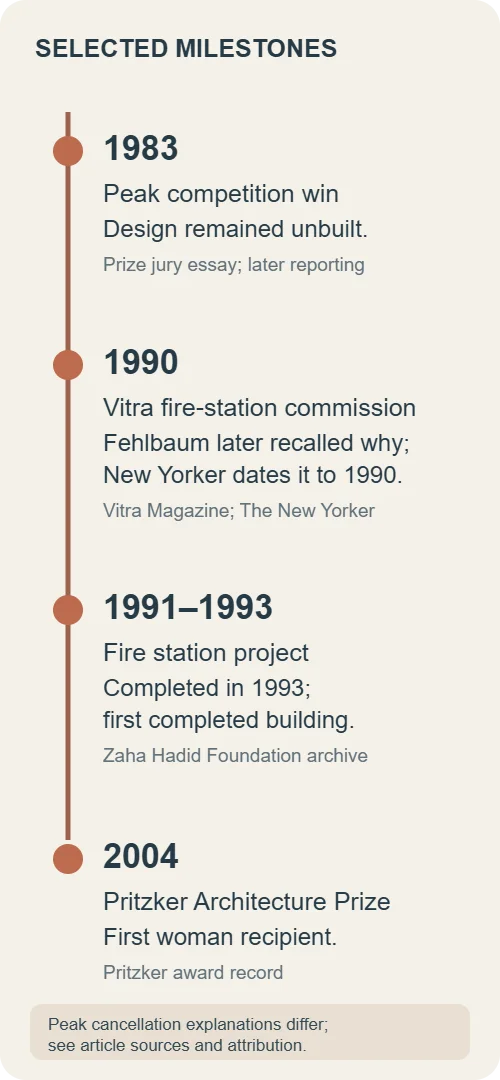
Key dates from the unbuilt Peak to the Pritzker Prize. Sources give different reasons why the Peak was not built.
What happened next
The fire station project ran from 1991 to 1993. The Zaha Hadid Foundation calls it Hadid's first completed building. Vitra calls it the first building complex she designed.
It was a working building, made for a real job. Vitra says its fire brigade could handle fires in their early stages. It could not replace public fire services, and the brigade was later disbanded.
In 2004, Hadid became the first woman to receive the Pritzker Architecture Prize. That came after many years of designing, teaching, competitions and practice. Some of her projects were built, and some were not.
No source says the Vitra station caused her later success. But it shows how a first building can happen. It took years of design work, a client with a practical need, a leader willing to trust drawings and a team able to build them.
This story inspires because the Peak was not the end. A win on paper did not become a building. Yet the work kept going, and a different door opened in a place no one planned.
Hard work cannot promise that any design gets built. But staying ready can help you say yes when the right chance comes.
Try this today
- Pick one idea you have kept "on paper." Spend 10 minutes making it clearer, so you could show it to someone tomorrow.
- Think of a practical need around you, at work or at home. Write down one way your skills could help with it.
- Thank someone who worked on a shared project with you. Name what they added.
Which of your ideas is waiting for the right practical chance?
Sources for this story: S01, S02, S03, S04, S05, S06, S07, S08. Full list below.
Join the conversation
Vote in the community poll and see the latest results from Armored Kitten on Telegram.