Nawal El Saadawi Was a Doctor Who Wrote. She Built a Group So Women Would Not Work Alone.
Egyptian doctor and writer Nawal El Saadawi turned what she learned from patients into books, then built a women's group with others that fought hard to survive.

The lesson
One voice grows stronger when it joins with others.
- Let the people who believe in you help you keep learning.
- Use what you see in your daily work to find what you want to say.
- Build a group around your cause, so no one has to carry it alone.
The challenge
Nawal El Saadawi grew up in Egypt. She later said that when she was ten, relatives tried to arrange her marriage.
In the same memories, she said her parents supported her education. She recalled that their support grew after her older brother struggled at school and she did well. Later accounts differ on some details of that childhood story.
She stayed in school. By her own account, she won a scholarship. In 1955, she qualified in medicine at Cairo University.
She said she chose medicine partly to please her parents. But studying medicine and examining patients gave her something new, she said. It gave her material for her writing.
The problem
After she graduated, El Saadawi went back to Kafr Tahla to work as a doctor. Later, she held a senior post in public-health education. Sources disagree on the year she started that job.
She wrote about health and about what society expected of women. Her book Women and Sex came out around 1970. Sources give different years for its first edition, from 1969 to 1972.
El Saadawi said the book was taken away by the censors. She linked it to the loss of her government job. She said she also lost a journal she edited.
Worse was to come. About ten years later, in September 1981, she was detained during a wider government crackdown under President Sadat. Accounts differ on how long she was held in prison.
Over those years, she lost a job, a journal and, for a time, her freedom. She also felt how isolated she was, working alone as a writer.
What they did
El Saadawi wanted something bigger than her own voice.
In the early 1980s, she and others founded the Arab Women's Solidarity Association, known as AWSA. Sources say it began in 1981 or 1982.
A 1991 report by the rights group Middle East Watch describes her goals. She wanted a group that could connect women's rights work. She also wanted to end the isolation she had felt working alone as a writer.
AWSA worked on women's rights, public discussion, research and publishing. Its mission was bigger than one writer's career.
Getting started was a struggle. The authorities refused to register AWSA until 1985. After a campaign, it was finally registered. Even then, it stayed under official supervision, with controls on its activities and publications.
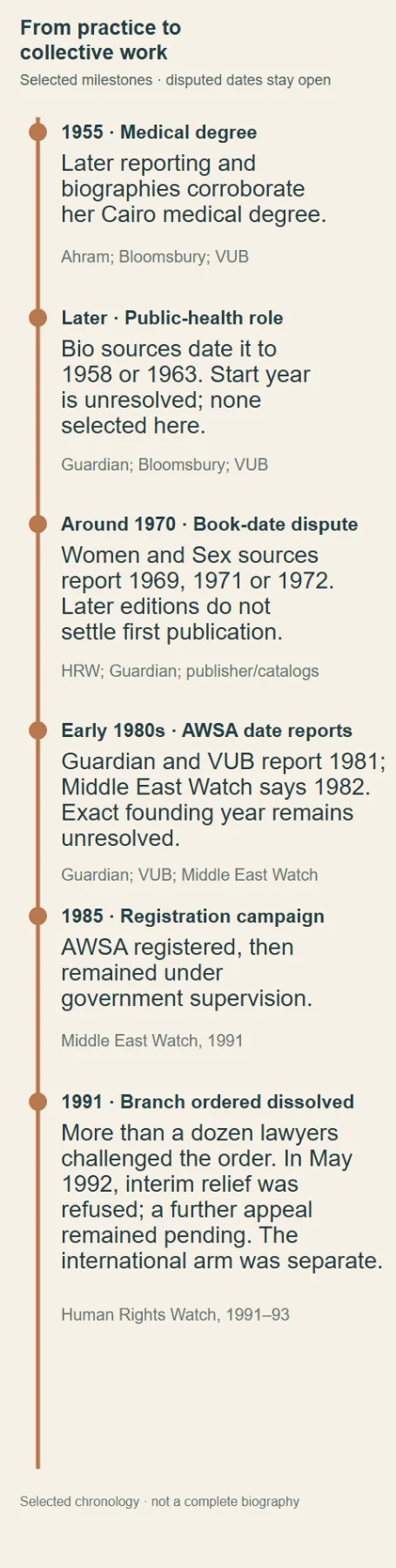
Selected dates from her medical degree to the fight over AWSA. Some dates are uncertain, including when her public-health job began and when Women and Sex first came out.
In June 1991, the government ordered AWSA's Egyptian branch to close. El Saadawi said the order froze the group's accounts and limited its work.
This time, she was not alone. More than a dozen lawyers volunteered to challenge the order in court. Women's rights groups and Middle East Watch spread the news and asked for support around the world.
What happened next
The support was real, but it did not win in court.
In May 1992, a court refused to pause the closure order. The order stayed in force while a further appeal was still waiting. The sources do not say how that appeal ended.
The international association was separate from the Egyptian branch. Human Rights Watch reported that it moved to Algeria.
El Saadawi's story is inspiring because of what she built. She drew on her medical work to write. When writing alone left her isolated, she built a group with others. When the group was threatened, lawyers and women's groups stood with it.
Support could not control every result. The government still closed the Egyptian branch. But her story shows how education, work, colleagues and volunteers can give one person's voice more room to grow.
Try this today
- Think about your daily work. Write down one thing you notice there that other people should hear about.
- Name two or three people who care about the same issue. Send one of them a message this week to share ideas.
- Thank someone who supported your learning when you were young. Set a reminder with Armored Kitten if that helps.
Who could stand with you, so you do not have to carry your cause alone?
Sources for this story: S01, S02, S03, S04, S05, S06, S07, S08, S09, S10, S11, S12, S13, S14, S15. Full list below.
Join the conversation
Vote in the community poll and see the latest results from Armored Kitten on Telegram.