Satyajit Ray's First Feature Film Ran Out of Money. Help Came Step by Step.
Satyajit Ray kept his day job, put in his own family's money and worked with a small crew on Pather Panchali, and different helpers carried the film forward at each stage.
The lesson
A stalled project can move again when you keep going with what you have and accept help one stage at a time.
- Start small with the resources you already have, and keep your income steady while you build.
- When you get stuck, ask who might help with the next stage.
- Give credit to everyone who helps you finish.
The challenge
Satyajit Ray worked in commercial art and illustration before he directed a feature film. His interest in cinema grew over many years. He later traced his wish to make films back to the 1940s.
Other filmmakers inspired him. A British Film Institute record notes his contact with the director Jean Renoir during the making of The River. It also notes the example of Vittorio De Sica's film Bicycle Thieves.
Ray wanted to make his own feature film, Pather Panchali. But he had no producer.
He later said he spent about a year trying to persuade producers to back his script. Private money did not come quickly enough. So he decided to start without it.
The problem
Ray built a small team. In a 1957 essay, he said the unit had eight people. Only one of them had worked in films before.
Ray did not quit his advertising job. He kept working there while making the film, so the project had to fit around paid work.
The group had 8,000 rupees in the bank. They hoped to film enough for a rough cut, a first version of the film. That could show a producer what they were able to do.
Ray helped pay for this himself. He later said the early filming used money borrowed against insurance policies. He also sold books and records. He used his wife's jewellery and part of his salary as an art director.
There were small setbacks too. Ray wrote that cattle once grazed through the kaash flowers they needed for a scene. The crew came back the next Sunday to try again.
Then came the big setback. Ray later said they had shot about 4,000 feet of film when the money ran out. They had footage, but not a finished film. Filming stopped.
What they did
Ray's accounts differ on how long the wait lasted. His 1957 essay describes two gaps in funding that added up to about a year and a half. A later interview tells it differently. A film archive says the work stretched over several years as money allowed.
The way back came through a suggestion. Ray remembered that someone told him to approach Dr. B. C. Roy, the chief minister of West Bengal. He did not name the person who gave that advice.
Money from West Bengal later let the crew return to filming. Ray said the government later got its money back from the film's early ticket sales.
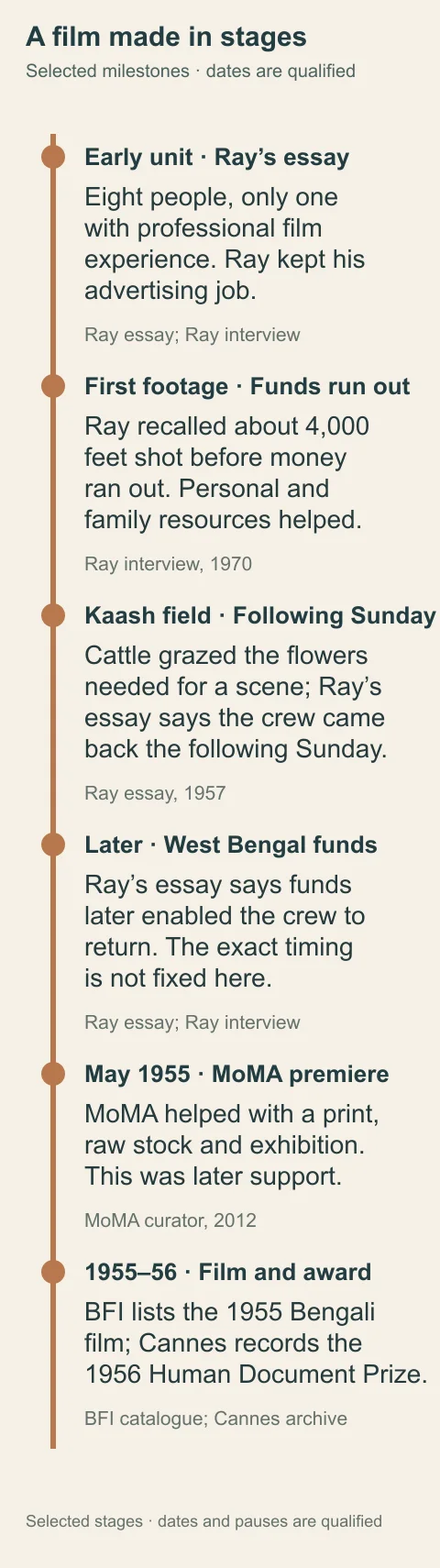
Selected steps in making and showing Pather Panchali. Ray's accounts differ on how long the funding gaps lasted.
Many people made the finished film. Ray's credits name the cinematographer Subrata Mitra, the editor Dulal Dutta and the art director Bansi Chandragupta. Ravi Shankar wrote the music. The Government of West Bengal is credited as the production company.
Later, a museum helped too. A curator at the Museum of Modern Art (MoMA) says the museum arranged a world premiere in May 1955. It also helped with a print of the film and with raw stock, which is unused film. This help was about showing the film, not paying to make it.
What happened next
Pather Panchali came out in 1955 as a Bengali-language film. Ray wrote and directed it.
Success did not come at once. Ray later said few people came to see it in India in the first two weeks. Then attendance improved.
The film also drew attention abroad. A 1959 review in the Harvard Crimson shows it was being discussed in the United States by then.
In 1956, the Cannes film festival gave it the Human Document Prize. This was a different award from the Palme d'Or.
Ray's story is inspiring because the film stopped and still got finished. He kept his job and put in his own and his family's money. He worked with a small, mostly new crew. When the money ran out, he followed a suggestion and found new support. Then other helpers carried the film to wider audiences.
Hard work alone did not finish the film. Family resources, a crew, a state government and a museum each helped at a different stage. Ray kept going long enough for each kind of help to matter.
Try this today
- Pick one project you have put off because you lack money or time. Spend 10 minutes planning a small first version you could make now.
- Write down one person or group who might help with the next stage. Find out how to contact them.
- List everyone who has helped with your work so far, and thank one of them today.
What could you start now with what you already have, while you look for the next helper?
Sources for this story: S01, S03, S04, S05, S06, S07, S08. Full list below.
Join the conversation
Vote in the community poll and see the latest results from Armored Kitten on Telegram.