Miriam Makeba Spent About 31 Years Away From Home. She Kept Making Music.
A short trip abroad in 1960 turned into decades of exile for Miriam Makeba, yet she kept singing, spoke out against apartheid, and built her work with many helpers.

The lesson
You can keep doing your work and using your voice, even far from home.
- Keep building with the skills you already have, wherever you end up.
- Accept different kinds of help from different people at different times.
- Speak up when the moment comes, and let trusted friends encourage you.
The challenge
Miriam Makeba was already a working singer in South Africa. She performed with groups such as the Manhattan Brothers and the Skylarks.
She also sang and appeared in a film, Come Back, Africa, made by Lionel Rogosin. The film had its first showing in Venice in 1959. The film and its director helped bring her to the attention of people outside South Africa.
On her travels, she met Harry Belafonte in London. The U.S. National Archives says he helped her enter the United States. He became an important partner and supporter. But he did not discover an unknown singer. She already had a career.
The problem
In 1960, Makeba went to the United States. The trip was meant to last four weeks.
It lasted much longer. In a 1990 newspaper interview, Makeba said that while she was in Chicago, a South African consul, a government official, stamped her passport invalid. That meant she could not go back home. This comes from her own memory, as reported 30 years later.
Now she was a singer in a new country, cut off from home. A short trip had turned into exile.
What they did
Makeba kept working, and many people helped in different ways.
Belafonte gave her advice as well as help. A 1988 newspaper profile says he urged her to be careful about how she behaved in public. One day, he told her, she might speak for her people.
The same profile names other mentors. TV host Steve Allen helped with her television career. Max Gordon, who owned the Village Vanguard club, helped with her club career. Her work grew through TV shows, club bookings, tours and recordings.
Then came a hard choice. E. S. Reddy worked with the United Nations committee against apartheid, South Africa's system of racial separation. He later wrote that he arranged a hearing for Makeba on 16 July 1963.
Reddy remembered that her agent told her not to appear. The agent feared it could hurt her career. Reddy said an anti-apartheid activist, Robert Resha, persuaded her to go ahead. Reddy also wrote that Resha "may have" helped her with a short speech.
So Makeba spoke at the United Nations while living in exile. This was three years after the passport problem, so the hearing did not cause it.
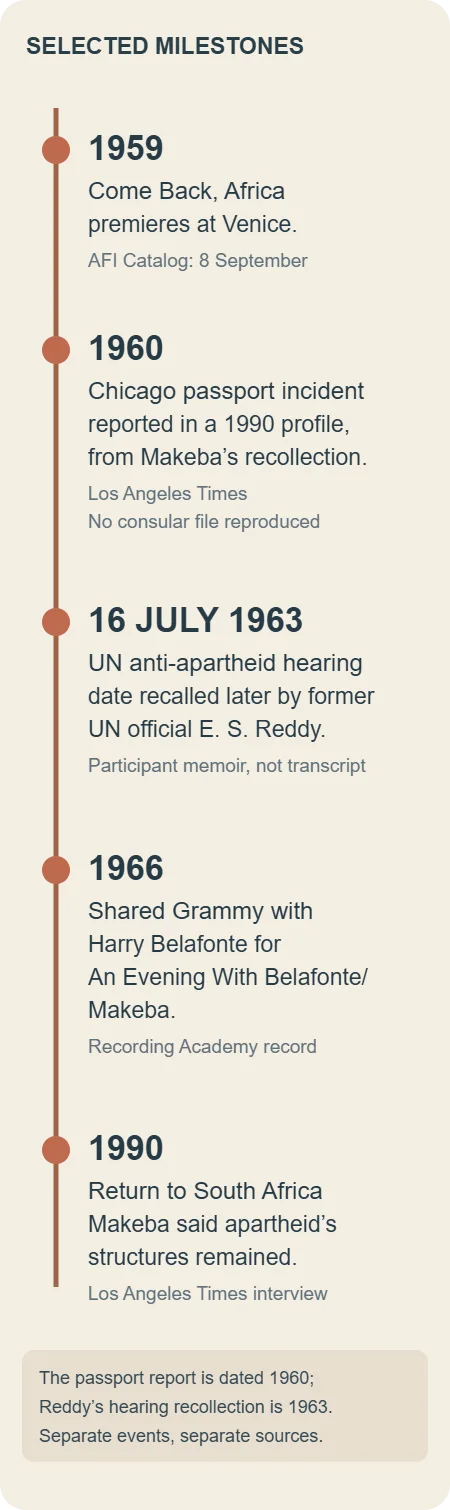
Selected dates in Makeba's life. The 1960 passport story comes from a 1990 interview. The 1963 hearing date comes from Reddy's later memoir.
Her work also won recognition. In 1966, Makeba and Belafonte shared a Grammy award for Best Folk Recording. The album was An Evening With Belafonte/Makeba.
The costs did not go away. Makeba later married Stokely Carmichael. She said that after the marriage, her American concerts and TV appearances stopped. Her recording contract with Reprise also ended. But she said she was never formally banned from entering the United States. She described losing work, not a legal ban.
What happened next
In 1990, Makeba returned to South Africa after about 31 years away.
The return meant a great deal to her. She spoke about the pain of missing her mother's funeral. She spoke about how much it mattered to visit her mother's grave.
She also gave an honest warning. She said the basic structures of apartheid were still in place. Coming home did not end the system that had kept her away.
Her story inspires because she did not stop. Her passport was declared invalid, and she spent decades away from home. Later, she lost work in America too. Through all of it, she kept singing, recording and speaking out.
She did not do it alone. A filmmaker, Belafonte, TV and club mentors, an activist and her audiences all played a part. None of them could undo her exile. But together they helped her keep her voice.
Try this today
- Write down one skill you can use wherever you are, even if your plans have changed. Spend 10 minutes on it today.
- Think of one person who gave you good advice at a hard time. Send them a short thank-you message.
- If there is something you want to speak up about, write three sentences you would say. Share them with one friend you trust.
If your plans changed tomorrow, what work could you still carry with you?
Sources for this story: S01, S02, S03, S05, S06, S07, S08, S09. Full list below.
Join the conversation
Vote in the community poll and see the latest results from Armored Kitten on Telegram.