Nina Simone Was Turned Away by a Music School. She Kept the Pianist Alive.
Eunice Waymon trained to be a classical concert pianist, was refused by Curtis, kept studying and working, and carried that training into the music of Nina Simone.

The lesson
A changed path does not erase the skills you have built.
- Keep practising your craft, even when the plan changes.
- Take the work you need now, and bring your full skill to it.
- Thank the teachers and family who helped you prepare.
The challenge
Before the world knew her as Nina Simone, her name was Eunice Waymon. She grew up in Tryon, North Carolina. Her dream was clear and specific. She wanted to be a classical concert pianist.
She had real help. A piano teacher, Muriel Mazzanovich, gave her formal classical lessons. Other people helped too. Accounts mention teachers, people who paid for lessons, and support for more schooling. It took a whole network to train her.
After high school, she spent a summer studying at Juilliard in New York. It was a short program to prepare her for the next step. Her goal was to apply to the Curtis Institute of Music in Philadelphia. Her family moved to Philadelphia while she worked toward it.
The problem
Then came the audition at Curtis. The Philadelphia Inquirer, using Curtis records, dates it to April 7, 1951. Another source, the National Women's History Museum, gives the year as 1950.
Curtis did not accept her.
It was a hard blow after so much preparation. In a 1992 interview, Simone said the refusal was painful. She said she believed she was turned away because she was Black. She also said it pushed her toward show business.
The reason for the decision is still disputed. The Inquirer reported that 72 pianists auditioned and only three got in. It said Black students had attended Curtis before. It also said no judge from the audition was still alive when it reported. Curtis teachers had not been required to provide audition notes. Some people the newspaper quoted doubted that race was the reason. None of this proves or disproves Simone's belief. The records simply do not settle it.
What they did
Eunice did not stop studying. The Inquirer reported that Vladimir Sokoloff, a piano teacher at Curtis, gave her private lessons for several years afterward. She hoped to audition again. That hope ended only when she passed an age limit.
She also kept working with music. She taught piano and worked as an accompanist, playing for other performers. Study and paid work went on side by side.
In 1954, she needed income. She took a piano job at the Midtown Bar & Grill in Atlantic City. There was one condition. The owner required her to sing as well as play.
This was not a planned change of image. It was part of the job. But it gave her a reason to perform songs beyond classical music.
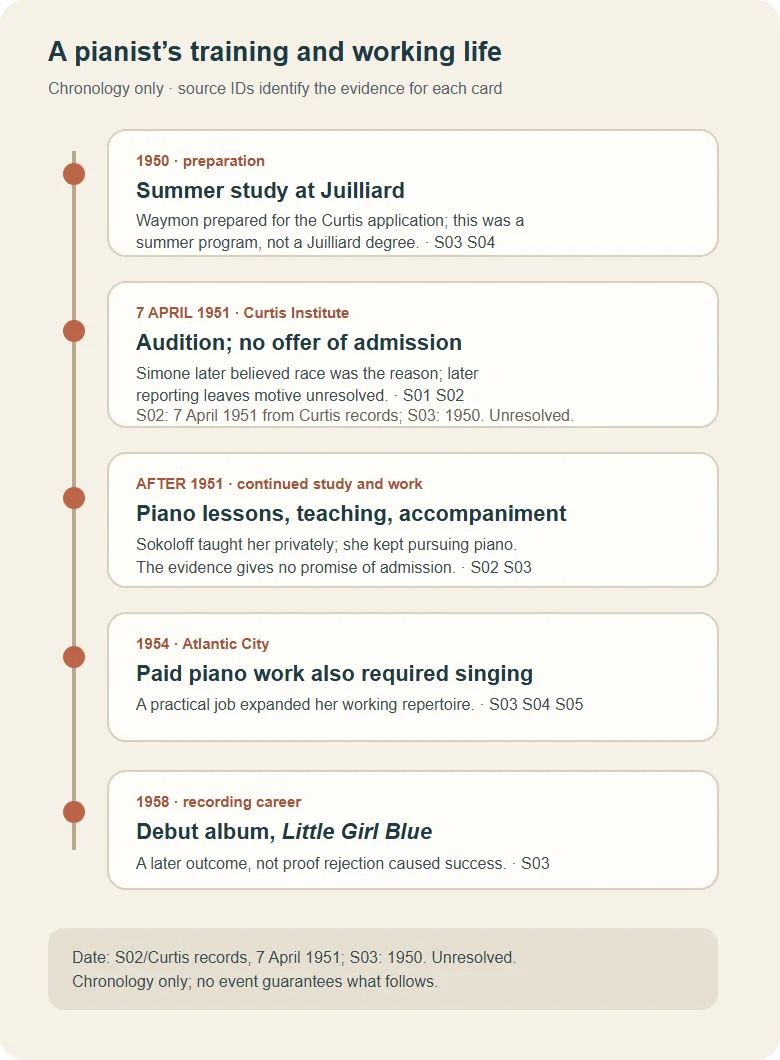
Key dates in her path from piano student to recording artist. Sources disagree on whether the Curtis audition was in 1950 or 1951. The timeline shows order, not cause.
The pianist did not disappear. In the 1992 interview, Simone said that songs she met through singer Arlene Smith's vocal studio became part of what she played. She improvised on them using the technique from her classical training.
She also had her own name for what she played. She called it "Black classical music." Those were her words, and they show the pianist was still there inside the singer.
What happened next
The bar job was one step in a long working life. The National Women's History Museum reports that her first album, Little Girl Blue, came out in 1958.
That was a different result from her first goal. She did not become a classical concert pianist. She became a recording and performing artist, known as Nina Simone. And she still carried her classical training into her music.
Her story inspires because she kept her skill alive through a painful change. She kept taking lessons, kept teaching, took the work that paid, and brought her full training to it. Her teachers, her family and the people who paid for her lessons all helped make that skill possible.
The rejection hurt, and it was not a gift. Not every closed door leads somewhere better. But her story shows that a new path can still carry everything you have learned.
Try this today
- Write down one skill you worked hard to build. Note one way you could use it in the work you do now.
- Spend 10 minutes practising that skill today, even if no one is asking for it.
- Think of a teacher or family member who helped you learn. Send them a short thank-you message.
Which part of your old plan still matters, and how could you bring it into your work now?
Sources for this story: S01, S02, S03, S04, S05. Full list below.
Join the conversation
Vote in the community poll and see the latest results from Armored Kitten on Telegram.