Beatrix Potter Paid to Print Peter Rabbit, Then Reshaped It for a Publisher
When publishers wanted a bigger, costlier book, Beatrix Potter printed a small edition with her own money, then revised it for a publisher in 1902.

The lesson
When someone says no to your work, find out what they object to, and keep the part that matters most.
- Separate the heart of your work from its current shape.
- Test your idea in a small way, using what you already have.
- Accept help, and change what can safely change.
The challenge
On September 4, 1893, Beatrix Potter sent an illustrated letter to a young boy named Noel Moore. It told a story about four rabbits. Noel was the son of Annie Moore, Potter's friend and former governess, or home teacher.
Potter had been sending picture letters to the Moore children for years. The children kept them. In 1900, Annie suggested that these letters might become books.
Potter borrowed the letters back. She copied, reworked and grew the rabbit story into a book draft. A copy she made of that first letter in 1900 still survives. She used it while she shaped the book. The original letter is kept in the archive of the publisher Frederick Warne.
Potter knew what she wanted. She pictured a small book that fit in a child's hands. It would cost less. Every page would have a black-and-white picture.
The problem
Publishers did not share her plan. Editors wanted a larger, more expensive book with color pictures. The draft was turned down. The Victoria and Albert Museum says at least six publishers declined it. Another record simply says "several."
The disagreement was mainly about the book's form: its size, its price and its color. The records do not show that editors thought the story itself was poor.
That left Potter with a hard choice. She could turn the book into something she did not want. Or she could find another way to put her version into readers' hands.
What they did
Potter decided to publish the book herself. She had already earned money by selling drawings and designs to a greeting-card company. She used her own money for this private edition. Not every creator has that option. Her earlier paid work helped make it possible.
On December 16, 1901, the printers Strangeways & Sons printed 250 copies of The Tale of Peter Rabbit. Another company reproduced her black-and-white pictures for printing. The pictures at the front of the book used a three-color process. In February 1902, Potter printed a second private edition of 200 copies.
These were small runs, shared with people close to her. One first-edition copy that still exists has a note inside, giving it as a Christmas gift to a cousin.
Meanwhile, other people helped keep a door open. Canon Hardwicke Rawnsley, a family friend, encouraged Frederick Warne to look at the book again. Warne made an offer in late 1901. One museum dates it to the same day as the private printing.
Warne's offer came with terms. Potter had to shorten the text and color the pictures. She took a private copy and cut eleven pictures. She rewrote the story until it fit 32 pages. She checked proofs of the words and the art. She also worked on the cover, the title page, the front picture and the color of the binding.
The new book was not a copy of her private one. It mixed her own choices with what the publisher needed.
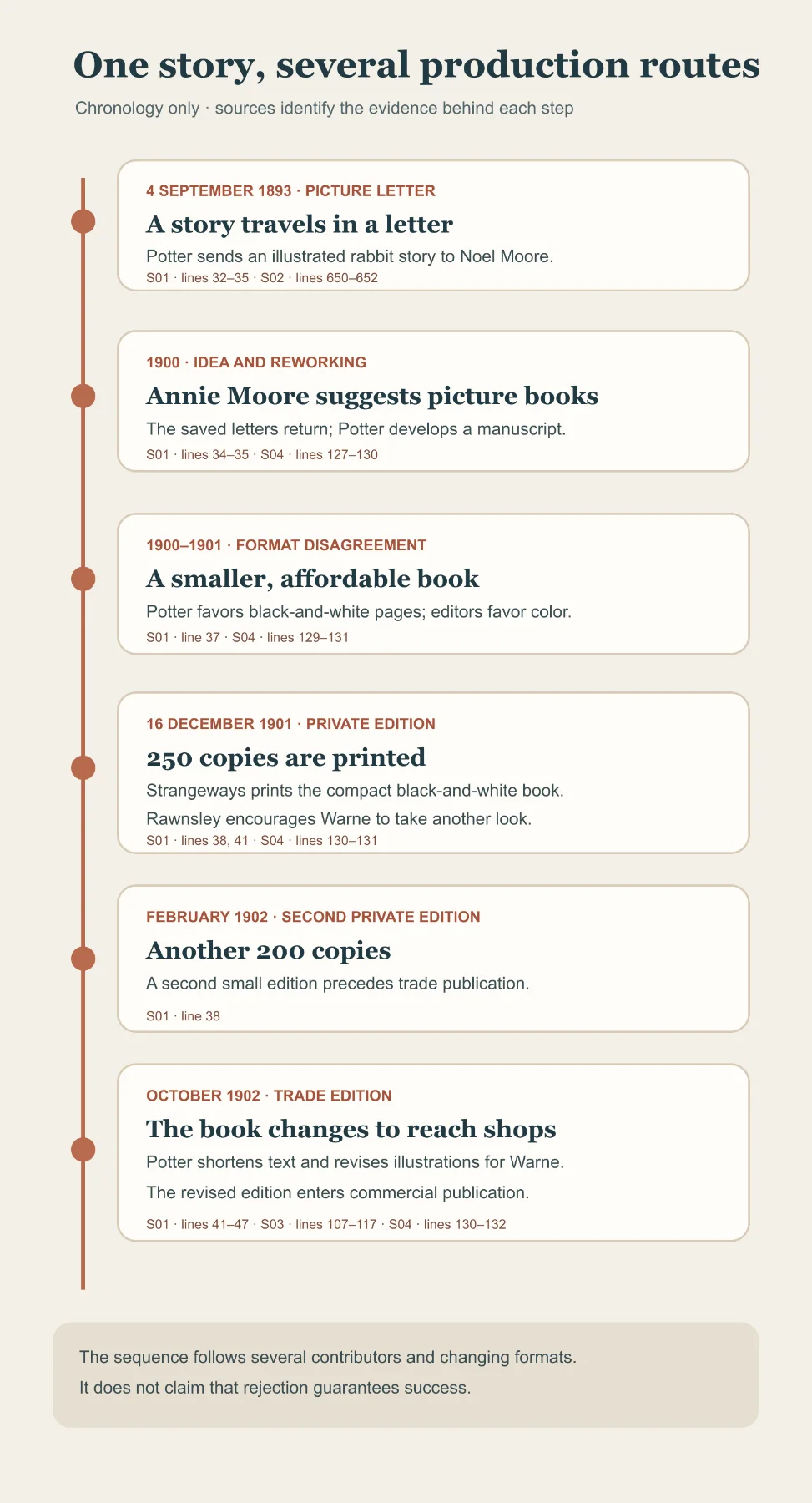
How the story moved from a letter, to a private book, to a shop edition, with help at each step. The private printing alone did not cause Warne's offer.
What happened next
Warne's edition of The Tale of Peter Rabbit came out in October 1902. The first printing was 8,000 copies, and more printings followed that year. Potter told one of the Moore children the book would soon be in local bookshops. By then, another printing was already under way.
A story that began as a letter to a child was now in shops. It took many hands to get there. The Moore children saved the letters. Annie had the idea. Rawnsley spoke up for the book. Print workers made it. Warne gave it a wider path. Potter wrote, drew, paid and revised.
Potter kept what she cared about where she could, and changed what she had to. Not every rejected book finds readers. But her story shows a useful habit: when you hear "no," ask which part is really being turned down.
Try this today
- Pick one project you care about. Write one line about what matters most in it, and one line about what you could change.
- Think of the last "no" you heard. Spend 10 minutes writing down what the person really objected to: the cost, the size, the timing or the idea.
- Name one person who helped your work, the way Annie Moore helped Potter. Send them a short thank-you message.
What is one small, safe way you could test your idea this week?
Sources for this story: S01, S02, S03, S04. Full list below.
Join the conversation
Vote in the community poll and see the latest results from Armored Kitten on Telegram.